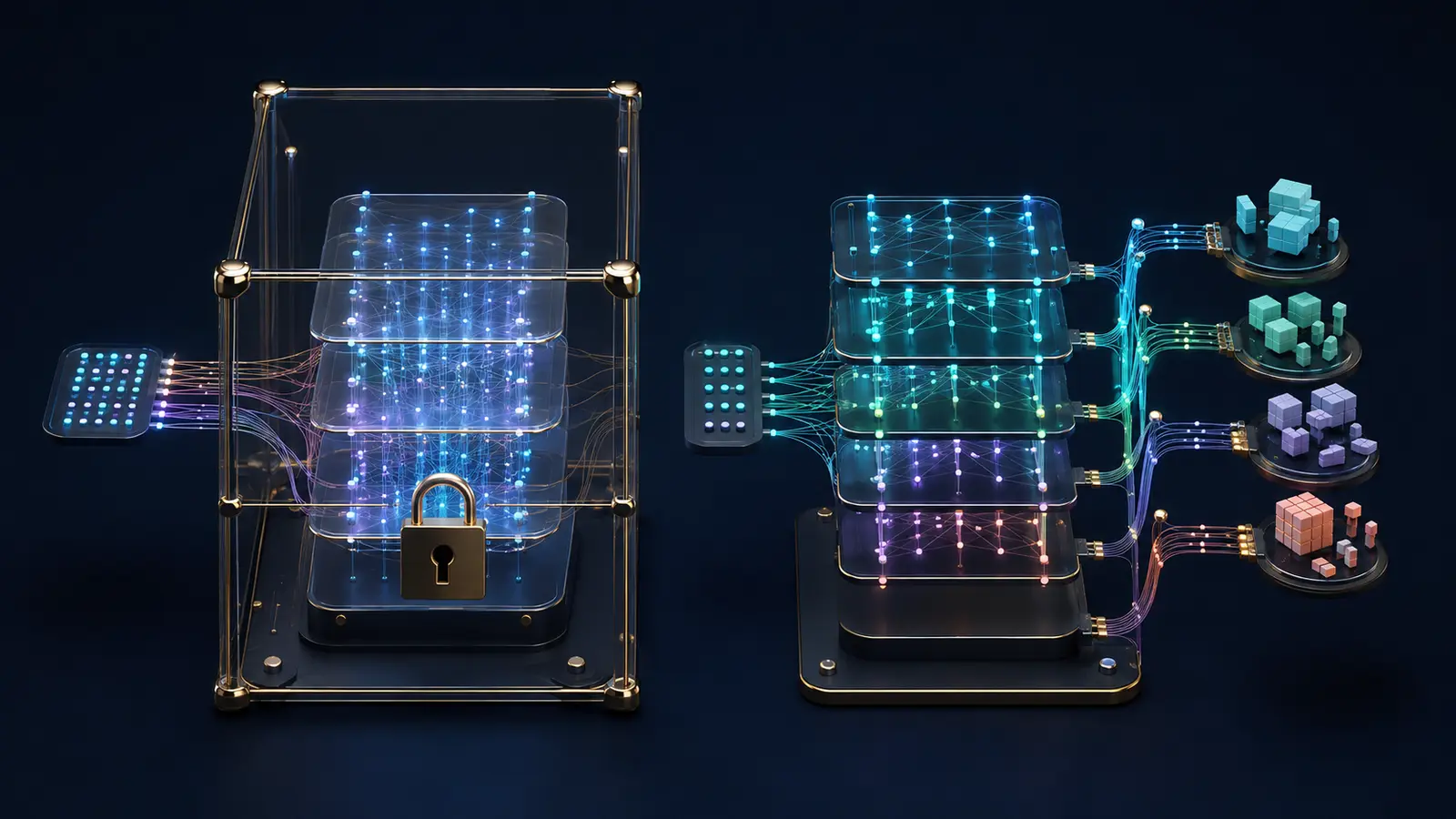
When a lab says its model is open, it almost never means open source in the sense the software industry has used that phrase for twenty five years. It means the weights are downloadable. What you may then do with them is decided by a licence, and those licences differ enormously.
Three things that all get called open
Open weights under a standard licence. The model files are published under an established, OSI approved licence such as MIT or Apache 2.0. You can run it, modify it, redistribute it, and build a commercial product on it, subject to almost nothing. DeepSeek-V4-Flash, released on 31 July 2026, ships under plain MIT. That is about as permissive as it gets.
Open weights under a bespoke licence. The files are downloadable, but the terms were written by the lab for this model. Moonshot AI’s Kimi K3 ships under a licence literally named the Kimi K3 Licence. Mistral Medium 3.5 ships under what Mistral describes as a modified MIT licence, and modified MIT is not MIT. NVIDIA’s Alpamayo 2 Super uses OpenMDW-1.1, which does permit fine tuning, derivative models, and commercial redistribution, but you have to read it to know that.
Open in the marketing sense only. A model announced as open where the weights have not actually been published. Alibaba announced Qwen3.8-Max on 3 August 2026 with a commitment to release open weights the following week. At the time of writing we could not confirm they have shipped, and we do not describe it as open until they do.
Why the distinction has real consequences
None of this matters for a weekend experiment. It matters enormously for four situations:
- Commercial products. Some bespoke licences restrict use above a revenue or user threshold, or exclude specific industries. Discovering this after launch is expensive.
- Redistribution. If you ship a fine tuned derivative to customers, you are redistributing. Standard licences permit this. Custom ones sometimes do not.
- Regulated environments. Legal and procurement teams have processes built around known licences. A one off licence means a manual review, which means delay.
- Longevity. Weights already downloaded under a permissive licence stay usable. A hosted model can be deprecated on the provider’s schedule.
The strategic picture has shifted
Meta spent years as the centre of gravity for open weight AI. That has ended. Meta Superintelligence Labs replaced the Llama family with the Muse line, Muse Spark is closed with only a stated hope to open source future versions, and llama.com now redirects to Meta’s developer site. Llama 5 was never released.
The momentum moved to DeepSeek, Alibaba’s Qwen, Moonshot’s Kimi, and Mistral. The capability gap has narrowed to the point where an open weight model you host yourself is a serious option rather than a compromise, particularly for teams whose data cannot leave their own infrastructure.
How to check before you commit
- Find the actual licence file in the model repository. Not the blog post, not the model card summary. The file.
- Identify whether it is a named standard licence or something bespoke.
- If bespoke, search it for the words commercial, redistribute, derivative, revenue, and users. Those are where the restrictions live.
- Check whether the licence covers outputs as well as weights. Some do.
- If you cannot answer these in ten minutes, assume it needs a legal review and budget the time.
For most teams the honest recommendation is simple. If licence simplicity matters more to you than the last few points of benchmark performance, start with a model under plain MIT or Apache and only move if you genuinely need to.